Wednesday, June 9, 2010

Saturday, May 22, 2010
Friday, April 23, 2010
Talking about mobility...
Jovens vão receber subsídio para viajar na Europa
I found this interesting article... Anyone heard anything about this?
I don't know how this is going to work but it can be a good idea to promote mobility!
I found this interesting article... Anyone heard anything about this?
I don't know how this is going to work but it can be a good idea to promote mobility!
Wednesday, April 7, 2010
Wednesday, March 17, 2010
Treaty of Lisbon
"Europe is not the same place it was 50 years ago, and nor is the rest of the world"
Monday, March 15, 2010
The Perfect European...

This is an interesting image with mismatched stereotypes of European cultures. Although it is meant to be humourous, it also makes us think about the stereotypes we have of ourselves and other cultures. Let me know what you think!
Thursday, March 11, 2010
Irena Sendler

I HAVE CHOSEN THIS LADY AS A GREAT EUROPEAN. THIS STORY CAME TO ME IN AN E-MAIL.
"Uma senhora de 98 anos chamada Irena Sendler acabou de falecer.
Durante a 2ª Guerra Mundial, Irena conseguiu uma autorização para trabalhar no Gueto de Varsóvia, como especialista de canalizações.
Mas os seus planos iam mais além... Sabia quais eram os planos dos nazis relativamente aos judeus (sendo alemã!)
Irena trazia meninos escondidos no fundo da sua caixa de ferramentas e levava um saco de sarapilheira, na parte de trás da sua camioneta (para crianças maiores). Também levava na parte de trás da camioneta um cão, a quem ensinara a ladrar aos soldados nazis quando entrava e saia do Gueto.
Claro que os soldados não queriam nada com o cão e o ladrar deste encobria qualquer ruido que os meninos fizessem.
Enquanto conseguiu manter este emprego, conseguiu salvar cerca de 2500 crianças.
Por fim, os nazis apanharam-na e partiram-lhe ambas as pernas e os braços e prenderam-na brutalmente.
Irena mantinha um registo com o nome de todas as crianças que conseguiu retirar do Gueto, que guardava num frasco de vidro enterrado debaixo de uma árvore no seu jardim.
Depois de terminada a guerra, tentou localizar os pais que tivessem sobrevivido e reunir a familia. A maioria tinha sido levada para as câmaras de gás. Àqueles que tinham perdido os pais, ajudou a encontrar casas de acolhimento ou pais adoptivos.
No ano passado, foi proposta para receber o Prémio Nobel da Paz, mas não foi seleccionada. Quem o recebeu foi Al Gore, por uns diapositivos sobre o Aquecimento Global .
Não permitamos que alguma vez esta Senhora seja esquecida!!"
Wednesday, March 10, 2010
European External Action Service
"...creation of a new European External Action Service (EEAS), intended as a diplomatic corps that will oversee not only Europe's huge aid and humanitarian budget but also relations with countries around the world."
http://www.europarl.europa.eu/news/public/story_page/030-63128-327-11-48-903-20091023STO63115-2009-23-11-2009/default_en.htm
http://www.europarl.europa.eu/news/public/story_page/030-63128-327-11-48-903-20091023STO63115-2009-23-11-2009/default_en.htm
Monday, March 8, 2010
Europe map puzzle

I found this website and I think it is very interesting, especially if you don´t know a lot about the geography of Europe. It´s an interctive game that allows you to match a european country or capital city with its place on the map. Try it out and test yourself!
Here is the link: http://www.yourchildlearns.com/mappuzzle/europe-puzzle.html
Saturday, March 6, 2010
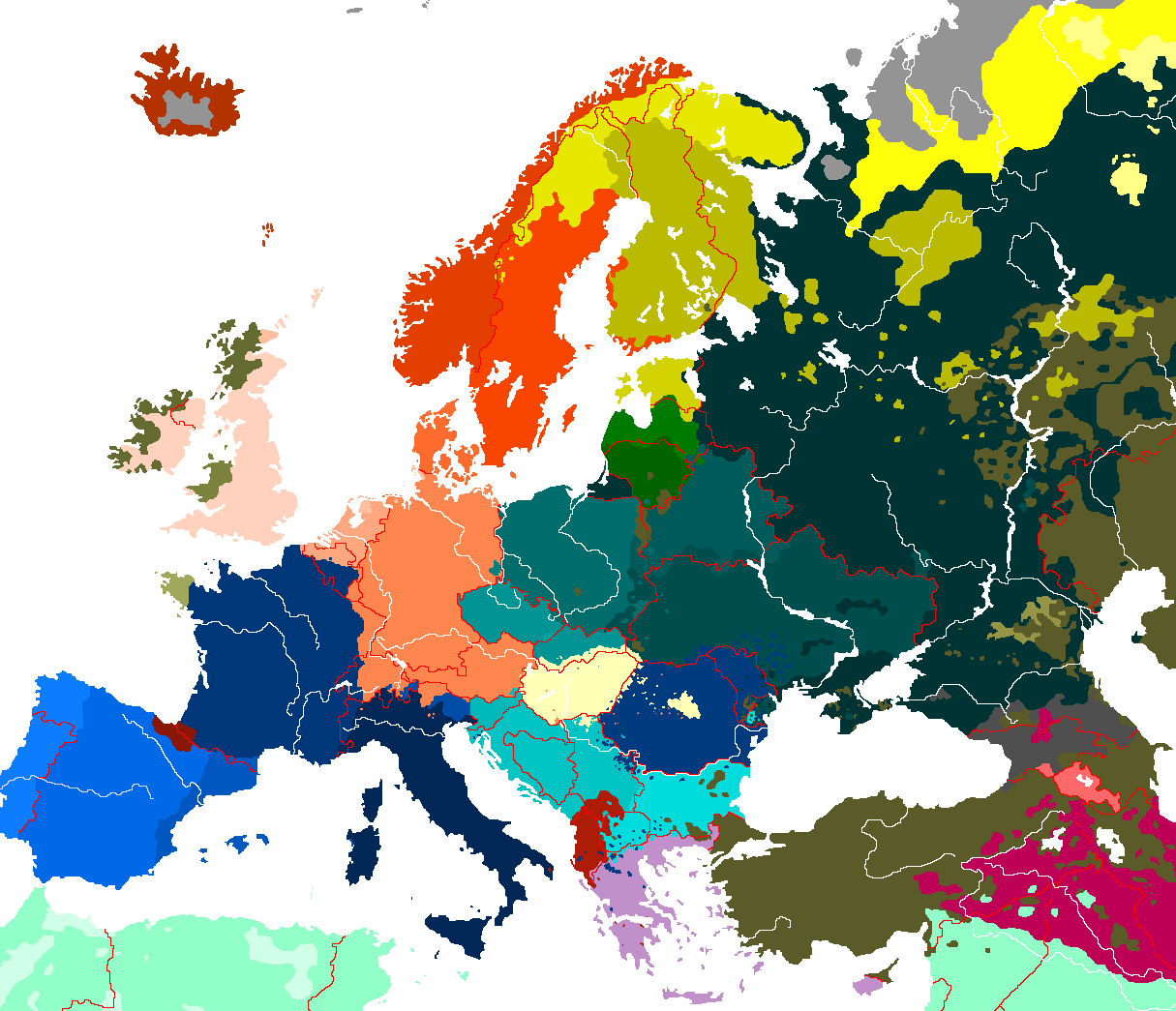
Map of Europe
 I also found a interesting map of Europe. The colors show the language groups of the countries.
To see more details, Click here !

Friday, March 5, 2010

Europa Myth

"Europa was the beautiful daughter of the Phoenician king of Tyre, Agenor. Zeus, the King of the gods according to Greek mythology, saw Europa as she was gathering flowers by the sea and immediately fell in love with her.
Overwhelmed by love for Europa, Zeus transformed himself into the form of a magnificent white bull and appeared in the sea shore where Europa was playing with her maidens. The great bull walked gently over to where Europa stood and knelt at her feet. The appearance and movements of the bull were so gentle that Europa spread flowers about his neck and dared to climb upon his back overcoming her natural fear of the great animal.
But suddenly, the bull rushed over the sea abducting Europa. Only then the bull revealed its true identity and took Europa to the Mediterranean island of Crete. There, Zeus cast off the shape of the white bull, and back into his human form, made Europa his lover beneath a simple cypress tree. Europa became the first queen of Crete and had by Zeus three sons: King Minos of Crete, King Rhadamanthus of the Cyclades Islands, and, according to some legends, Prince Sarpedon of Lycia. She later married the king of Crete, who adopted her sons, and she was worshiped under the name of Hellotis in Crete, where the festival Hellotia was held in her honour. At last, Zeus reproduced the shape of the white bull, used by Zeus to seduce Europa, in the stars."Source: http://phoenicia.org/europa.html
What happened to the European ideal?
"People suffered of centuries of wars in Europe, tried so many times to stop what seemed an inexorable repetition of bloody confrontations. Not long after the First and the Second World wars, what has probably been the lowest point of history, came the most ambitious project, the only one that could cure Europe for good, the European Union. We take now for granted peace in Europe. It appears so fundamental and natural. The project of the European Union has not been built by romantic people bored in their bourgeois living rooms. It has been made by necessity. The real ideal behind the euro is not to make international corporations richer, it is that commerce between nations prevent them from going to war. Democracy and freedom is not so much about individualistic rhetoric, but is an effective way to prevent a country’s elite to declare war without a real necessity for its population. The point is that all of this is working! After centuries of blood, we have now found a way to prevent war."
Source: http://bruchansky.name/2009/06/09/what-happened-to-the-european-ideal/
Source: http://bruchansky.name/2009/06/09/what-happened-to-the-european-ideal/
Wednesday, March 3, 2010
Europe in the 21st century - Treaty of Lisbon
The Treaty of Lisbon entered into force on 1 December 2009. It provides the EU with modern institutions and optimised working methods to tackle both efficiently and effectively today's challenges in today's world. In a rapidly changing world, Europeans look to the EU to address issues such as globalisation, climatic and demographic changes, security and energy. The Treaty of Lisbon reinforces democracy in the EU and its capacity to promote the interests of its citizens on a day-to-day basis.
Source: http://europa.eu/lisbon_treaty/index_pt.htm
For those who are interested in the Treaty of Lisbon details.
Full text of the Treaty
http://europa.eu/lisbon_treaty/full_text/index_pt.htm
Source: http://europa.eu/lisbon_treaty/index_pt.htm
For those who are interested in the Treaty of Lisbon details.
Full text of the Treaty
http://europa.eu/lisbon_treaty/full_text/index_pt.htm
Subscribe to:
Posts (Atom)